 Rafflers Certified Draws
Cloned Facebook Pages
Cloned Facebook pages are something that comes with the territory on Facebook. After all, the details on any Facebook profile are on view and public, ready for easy duplication. Some cloned Facebook pages are obviously fake, and others are very well presented as the legitimate page.
Most pages that are cloned will simply duplicate the information as close to the original and genuine page as possible. They will work to build followers and likes as soon as they can and will attempt to fool their followers into entering a fake and illegal raffle (prize competition). They will eventually be shut down, but by then they have stolen enough money from entrants to have made it worth their while!
A huge majority of online raffle providers will use their business Facebook page as a genuine way of reaching their fans! Furthermore, they will use this platform as a trusted source for their LIVE draws! The last they need is their account being cloned as It can be devastating for their business and reputation.
What to Look Out for
Let’s look into what to look out for when browsing Facebook for online raffle providers. The following are the most common things to be aware of and although some may seem obvious, it really is worth just using this guide as a check list, just incase!
Inconsistent Branding
Legitimate Online Raffle providers work their socks off on marketing themselves with very well thought out and consistent branding! They will use the same colours and design for the majority of their images and videos. A cloned Facebook Page may have the same profile photo or cover photo but you may notice an inconsistency in colours in the various posts uploaded top the page. These slight differences can be a clue that the page is fake!
Too Good To Be True Offers
Cloned pages often make enticing offers that can seem too good to be true. This can include promising expensive prizes, free products, or cash giveaways in exchange for simple actions like sharing, liking, or commenting on posts. This is a common practice for legitimate Facebook pages but you’ll find they will giveaway, for example, a £50 Amazon voucher or something similar. If a facebook page is offering a huge prize, such as a house or car, for simply sharing a post, then certainly be cautious!
Poor Grammar and Spelling
Scammers might not pay close attention to grammar and spelling, leading to poorly written posts and comments. Spelling mistakes can happen, but be aware if poor grammar and punctuation appears consistently throughout the Facebook page.
No Website Link
If there is no website link anywhere on the Facebook Page then it is almost definitely fake! A legitimate online raffle provider cannot run without a website.
No Response to Messages or Comments
The scammer behind a cloned or fake Facebook page is not interested in interacting with you! If you send a message or ask a question you will most likely find that you will never receive a reply!
Amount of Followers Compared to Posts
People tend to assume that a Facebook Page with a high amount of ‘followers’ or ‘likes’ is a genuine page ,and the majority of these pages are legitimate. However, it is possible for anyone to purchase ‘follows’ and ‘likes’ from a huge list of third party companies and many scammers use this service to convince innocent people that they are legitimate. The people who provide such a service create thousands of facebook accounts and use these to follow and like pages for a small fee! A certain option for the scammer looking to clone a business page.
A high amount of likes and follows should be accompanied with a good history of posts on the pages timeline. So, first thing to do is scroll down and see how many posts have been uploaded. In theory, you should be scrolling for some time, especially if the likes and follows are in their thousands!
If there are plenty of posts on the page and the followers and likes are high then so far so good!
Let’s do some further checks..just incase!..
Page Creation Date
Every Facebook Page has a section where you can check when the page was created. You can check yourself by doing the following:-
- Just underneath the profile photo for the Facebook Page you will see a menu. Click on ‘About’.
- Then click on ‘Page transparency’
- You should see the Page ID and also the Creation Date. This date is the day that the Facebook Page was created.
The desktop image below shows this process and is the same for mobile phone too.
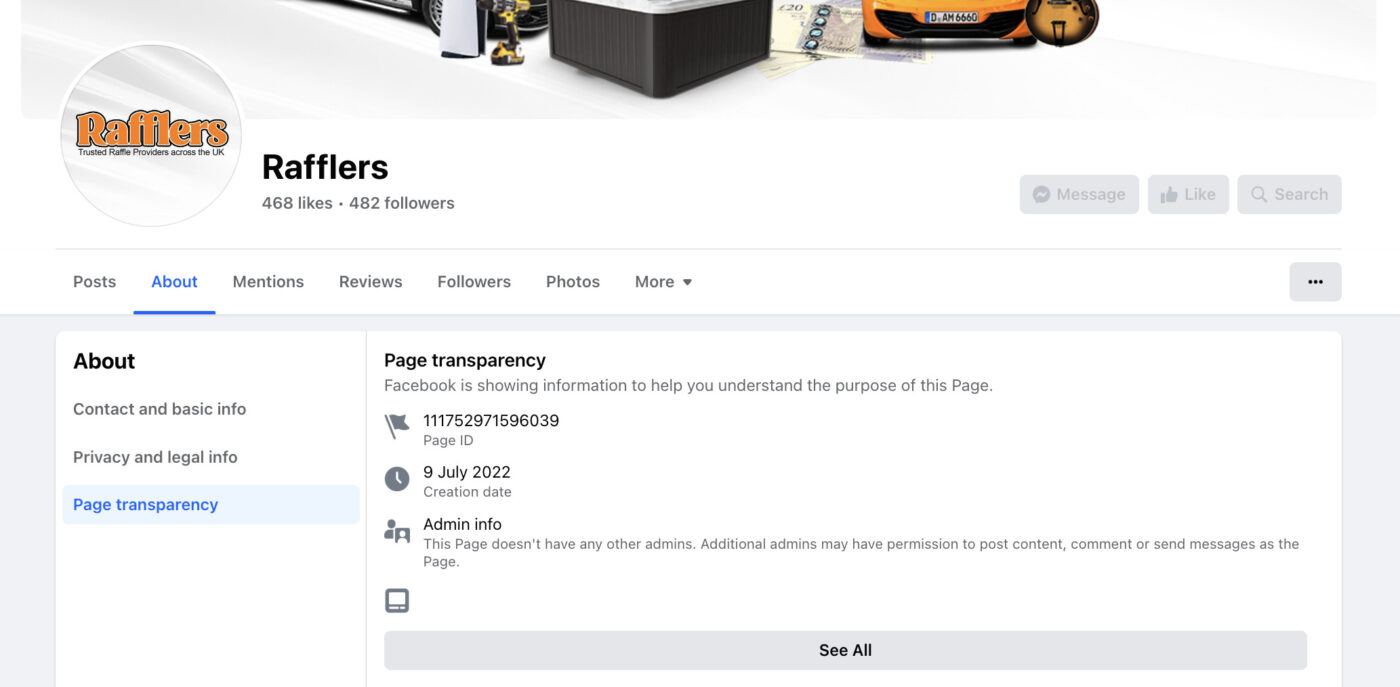
This date is very important in determining if a Facebook Page is genuine or not. If, for example, the Facebook Page has thousands of followers but was only created a few weeks ago, it could be fake or a cloned account. In this situation you should proceed to check through the posts made by the account holder. Are there many posts? If it all looks very minimal and doesn’t seem to marry up with the quantity of followers and likes, then it could be a fake page.
Contact Details
In the same way you can check the creation date of the page, you can also check the contact details of the page owner. If you cannot find any contact information eg email address, business address or website address in this section then it could be a fake account.
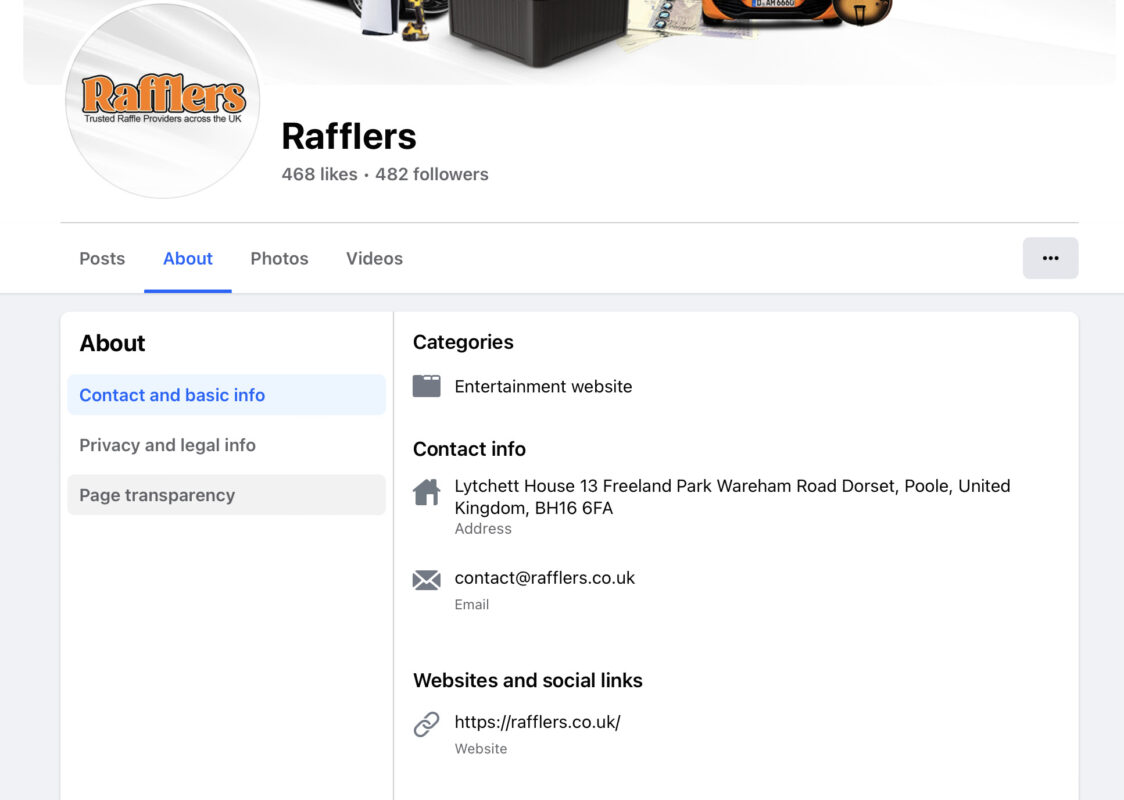
The absolute most important part of the contact details is the website address. A legitimate online raffle cannot run without a website.
No website address? People do sometimes forget to add a website address, so scroll down through the pages posts to see if there is any sign of a link to a website. Specifically check the post text to see if there are any links to a website at all!
No links? No website? Assume the page is fake and report to Facebook. Please do also let us know so we can add this to our list of scammers!
Facebook is the most common platform for online raffle scams. To learn more, have a look at ‘Online Raffle Scams’
Cloned Facebook Pages & Online Prize Draw Scams – FAQs
A cloned Facebook page is a fake account that copies the name, images, branding, and information of a legitimate business page. Scammers create these pages to impersonate genuine online prize draw providers. Their goal is usually to trick people into entering fake or illegal prize draws and paying money for prize draws that do not exist.
Scammers clone online prize draw Facebook pages because these businesses often have large audiences and active followers. By copying the real page, scammers try to gain trust quickly, build followers, and promote fake competitions or giveaways. By the time the page is reported and removed, they may have already collected entry payments from victims.
There are several warning signs that a Facebook prize draw page may be cloned or fake, including:
-
Inconsistent branding compared to the real page
-
Unrealistic giveaways or prizes that seem too good to be true
-
Poor spelling and grammar across posts
-
No website link connected to the prize draw provider
-
No response to messages or comments
Checking these factors can help you identify fake prize draw pages before entering any draws.
Legitimate online prize draw providers usually invest time in consistent branding, including colours, logos, graphics, and design styles across their posts and videos. If a Facebook page has mixed branding, inconsistent colours, or low-quality graphics, it could be a cloned Facebook page attempting to copy a real prize draw business.
A genuine online prize draw business cannot operate properly without a website. The website is where draws are hosted, tickets are sold, and terms and conditions are provided. If a Facebook page promoting prize draws does not link to an official website, this is a major warning sign that the page may be fake or cloned.
Scammers can purchase fake Facebook followers and likes to make their page appear popular. A warning sign is when a page has thousands of followers but very few posts or little history. A legitimate prize draw page usually has a long timeline of posts, live draws, and regular engagement with followers.
You can check the creation date of a Facebook page using the Page Transparency section:
-
Go to the Facebook page
-
Click About
-
Select Page Transparency
This section will show the Page ID and the date the page was created. If the page was created very recently but already has thousands of followers, it could be a cloned Facebook page or scam prize draw account.
A legitimate online prize draw provider should normally provide clear contact details, such as:
-
A website address
-
A business email
-
A registered business address (in some cases)
If a Facebook page promoting prize draws has no contact information or website, it may not be a legitimate business.
If you suspect a cloned Facebook page promoting fake prize draws, you should:
-
Avoid entering any prize draws
-
Report the page to Facebook
-
Warn others in the comments if possible
-
Check the official website or verified social media accounts of the genuine draw provider
Taking these steps helps protect others from online prize draw scams and cloned social media pages.